In the interest of trying to write more, here's a thought I had. I'm not sure how far into it I can explore, because it seems like just a small thought, but I'll try to go as deep as I can.
While I worked at the day care, I was constantly tying shoes. Why do parents keep buying shoes that tie for children that don't know how to tie them? Is it because they want to retie them multiple times a day themselves?
It's so that the kids can learn to tie, one might reply.
Yeah, that's not practical. In today's world, there's no time for that. When the shoes go on the feet, that means it's time to go. Ideally in that situation, a parent could announce that it was time to leave, tell a child to go put on his shoes, and then wait patiently until the child has his shoes tied. In reality, a parent doesn't have the time or patience to wait and inevitably winds up tying the shoes herself.
The Montessori way would be to never buy clothes or shoes that a child can't put on my himself (okay, past infancy). To teach shoe tying, a parent could provide, during down times only, one of their own shoes or a tying frame and slowly model. Shoes for a child that tie would only come after tying is mastered. It might even be considered an incentive for learning. Child asks for shoes that tie? They must first demonstrate that they can tie the shoes.
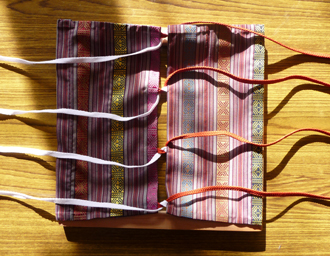
Montessori curriculum uses dressing frames to assist children in learning these practical life lessons. Again, they're used during down times, not at the time a child is expected to dress herself. As far as shoe lace learning is concerned, here is both a lacing frame and a tying frame. Here's a video of the actual lesson a Montessori teacher would give using the tying frame. I love how everything is done multiple times to reinforce each action. (I've linked to Nienhuis because their pictures are nice, but you could definitely make them yourself using fabric, ribbon, and an old picture frame from the thrift store. Michael Olaf made a gorgeous one while teaching in Bhutan. Or, you know, whatever. Cardboard and cardboard boxes work just fine.)
Or if your child is struggling with his fine motor skills and just needs to get the right movements down first, you can always turn tying into a gross motor activity by using a giant shoe or giving him a jump rope.
And if the method is difficult, there are a myriad of alternative ways to tie shoes. One of them will surely be easier for your child than the traditional method! There are a lot of videos on the Ian Knot, and it sure does look promising!
Wednesday, June 12, 2013
Saturday, June 8, 2013
A Year In Review--Facebook Statuses from My Time at the Daycare
Well, another chapter in my life has come to an end. Yesterday was my last day at the daycare.
Overall, it was a good experience. Having not had the opportunity to babysit when I was younger, I didn't really have any experience with very young children, and actually, before I started, it was quite daunting. I hadn't ever really talked with kids this age, hadn't played with them, hadn't changed a diaper.
Now I can say that I'm confident working with small children. And what a feeling it is to be able to say that! I am certain that I don't want to work with this age as my career, but confidence was absolutely worth the year I put in.
To celebrate the end of this chapter, I have compiled ALL of the Facebook statuses I've posted about the children over the past year. I've also annotated some for further information. Listen under a cut because there are so many.

Friday, May 31, 2013
Not a Book Review--A Look at Gun Play
About six months ago, I read Killing Monsters: Why Children Need Fantasy, Super-Heroes, and Make-Believe Violence by Gerard Jones. It was a fantastic book, and I learned a lot from it. I began taking notes, like I normally do, but I soon realized that it was too time-consuming, so I began highlighting instead. In fact, I found so much of the book important that I probably literally highlighted a full third of the words in the book.
And that was my trouble. That's why I never posted a book review of it--I wanted to take so many clippings from it that when I imagined finally finishing the post, I almost feared I'd be arrested for copyright infringement. You know, for publishing so much of the book online that it doesn't even seem to be a review anymore, but rather an abridged copy.
Anyway, I lent the book to my boss at the day care, hoping it would spark his passion as much as it did mine. He seemed to be excited for it, but then he gave it back to me, partially read and stained from a coffee spill, saying that he didn't have enough time anymore. (And yet I saw a copy of Ayn Rand on his desk. Yep.) I told him that it was fine, but what did he think of it? He replied that, while he certainly didn't agree with everything in it, there were some things that made him think. I let the issue drop, deciding to be happy with that at least.
I've always allowed gun play in classrooms that I've been in at the daycare. My Montessori background leads me to believe, and my reading now supports, that whatever children play is something that their mind is trying to make sense of, and thus beneficial to their development. I always try to observe closely and watch for children that are made uncomfortable by it, but actually, that's never come up. The other children either play along or ignore the gun-player completely.
The only time it's ever an issue is when another child remembers rules that adults have enforced upon them and looks to me to see if I will enforce consistent rules. And then I ask the child why we have that rule, to which they reply with something like, "Guns are bad." Again, I ask, "Why is that?" Usually they shrug and wander off at that point, but if they reply with, "Guns hurt people," then it seems that they have a clear concept of a gun as a weapon and I bring the other child into the conversation with something like, "X says guns hurt people. Are you trying to hurt people?" and so forth until we establish that the play is pretend.
But honestly, I prefer gun play to a lot of other types of play, especially horse play. (What a silly term. It's absolutely fine to pretend to be horses!) There was one class of two-and-a-half-year-olds that played guns more frequently than the others. (They have since been broken up into separate classrooms through the natural progression of aging in a medium-sized daycare center, and a couple of them have termed, dropped out for various reasons.) They were a rambunctious bunch of boys and girls, but when they were standing, pointing their fingers at each other, and then falling over, I didn't have to worry that they were tackling and physically harming one another. (Not that bumps and bruises aren't a natural part of childhood, but, as I learned in Killing Monsters, adult women are less comfortable with physical play than adult men and the children themselves are.) Plus, I saw a lot of compassion in that play, led by a certain female child. When someone would fall over after being "shot," she would rush to their side, smush their chin between her palms, and coo sadly, even if she was the assailant! Sure there was a lot of, "Get 'em!" but there was also a lot of, "Help me!" and friends running over to comfort an "injured" buddy.
Once while I was in this class, a neighboring teacher looked in, saw gun play occurring, and reprimanded the kids. My kids. Okay, they weren't really "my kids," because I'm a float teacher, not the lead teacher in that classroom. Aaaand, technically, a few of them were drop-ins from her classroom, so they were more her kids than mine. But still! She was undermining my authority while I was in charge of the class and confusing the children with mixed messages about what was allowable and what was not. So I told her, still with the shy and polite manner I have, even though I was frustrated, that we have different philosophies on this topic. She proceeded tell me about a child in a public school where there was a no-tolerance policy for guns that got expelled for pointing a breakfast pastry, fashioned into the shape of a gun, at a friend. "We have to stop it here," she explained. "These kids will be going into the public schools," though, admittedly, perhaps not the ones with no-tolerance policies, "so we have to stop it here." I was at a loss for words. What? What about all the amazing things I had just read in Killing Monsters? What to say? What to say? Had I learned nothing? Seeing as I didn't have a reply, she left, smugly.
Another time, I was in a preschool classroom with four-year-olds. It was nearing the end of the day, and a number of children had decided to play guns with Legos. One of the boys' mother came in and saw the play. Visibly shaken, she addressed her son, "Are you playing guns?" She roughly took the blocks out of her child's hands and threw them on the ground. "You better not do that again." I have to say something!, I knew. I couldn't let this turn out like last time. "Children absolutely know the difference between pretend violence and actual violence," I offered, not quite as firmly as I could have. She addressed me for the first time, "Well, I don't know. I'm a gun owner, myself, but I don't know... Come on, we need to go tell [boss's name] about this," she told her son passive-aggressively, taking him by the hand. There was nothing else I could do.
A few minutes afterwards, an expected appearance from the boss, but not, by the way, the one who I offered the book to. He confirmed that the child was in my class, first, then told me that his mother had made a complaint about gun play in my class. "It's a policy here that we don't allow gun play of any kind. No weapons at all--no guns, no knives, no swords," he told me. Huh. Well, I had seen a number of teachers disallow gun play, but it was never discussed, not in any manual I read upon hire, nor on any signage on the walls. "Really? I've never heard that. Is it posted somewhere?" I asked. But instead of responding to politely as I had done, he chose a snippy reply, almost hostile, complete with finger pointing, "I'm posting it to your brain right now. Don't. Do it." He left, leaving me to finish out the day in my tearful frustration.
Whatever, I decided. At that point, I only had about two months left to work at the center before leaving for Montessori training, so I decided to play by the "rules," unposted or not, rather than ruffle any more feathers. I heard later from a coworker in the office that said boss actually thought the complaint was silly. He sure didn't act like it when he spoke with me. Since then, every time a child has mentioned a gun in their play, I've told the child compliantly, "No guns."
Gah, what happened to all the facts and insights I had read? Had I not internalized it? Perhaps I really had highlighted too much. And, definitely, not going over the notes again by posting them here wasn't helpful. So.. actual book review of Killing Monsters to come.
But on the day that I was spoken to, after the boss left, the remaining children still wanted to resume the game. I told them, "No guns," a couple of times, but one child was adamant. Eventually, after a few trials of what he could play without comment from me, his gun turned into a "flower wand" that turned everything it shot into a flower.
And that was my trouble. That's why I never posted a book review of it--I wanted to take so many clippings from it that when I imagined finally finishing the post, I almost feared I'd be arrested for copyright infringement. You know, for publishing so much of the book online that it doesn't even seem to be a review anymore, but rather an abridged copy.
Anyway, I lent the book to my boss at the day care, hoping it would spark his passion as much as it did mine. He seemed to be excited for it, but then he gave it back to me, partially read and stained from a coffee spill, saying that he didn't have enough time anymore. (And yet I saw a copy of Ayn Rand on his desk. Yep.) I told him that it was fine, but what did he think of it? He replied that, while he certainly didn't agree with everything in it, there were some things that made him think. I let the issue drop, deciding to be happy with that at least.
I've always allowed gun play in classrooms that I've been in at the daycare. My Montessori background leads me to believe, and my reading now supports, that whatever children play is something that their mind is trying to make sense of, and thus beneficial to their development. I always try to observe closely and watch for children that are made uncomfortable by it, but actually, that's never come up. The other children either play along or ignore the gun-player completely.
The only time it's ever an issue is when another child remembers rules that adults have enforced upon them and looks to me to see if I will enforce consistent rules. And then I ask the child why we have that rule, to which they reply with something like, "Guns are bad." Again, I ask, "Why is that?" Usually they shrug and wander off at that point, but if they reply with, "Guns hurt people," then it seems that they have a clear concept of a gun as a weapon and I bring the other child into the conversation with something like, "X says guns hurt people. Are you trying to hurt people?" and so forth until we establish that the play is pretend.
But honestly, I prefer gun play to a lot of other types of play, especially horse play. (What a silly term. It's absolutely fine to pretend to be horses!) There was one class of two-and-a-half-year-olds that played guns more frequently than the others. (They have since been broken up into separate classrooms through the natural progression of aging in a medium-sized daycare center, and a couple of them have termed, dropped out for various reasons.) They were a rambunctious bunch of boys and girls, but when they were standing, pointing their fingers at each other, and then falling over, I didn't have to worry that they were tackling and physically harming one another. (Not that bumps and bruises aren't a natural part of childhood, but, as I learned in Killing Monsters, adult women are less comfortable with physical play than adult men and the children themselves are.) Plus, I saw a lot of compassion in that play, led by a certain female child. When someone would fall over after being "shot," she would rush to their side, smush their chin between her palms, and coo sadly, even if she was the assailant! Sure there was a lot of, "Get 'em!" but there was also a lot of, "Help me!" and friends running over to comfort an "injured" buddy.
Once while I was in this class, a neighboring teacher looked in, saw gun play occurring, and reprimanded the kids. My kids. Okay, they weren't really "my kids," because I'm a float teacher, not the lead teacher in that classroom. Aaaand, technically, a few of them were drop-ins from her classroom, so they were more her kids than mine. But still! She was undermining my authority while I was in charge of the class and confusing the children with mixed messages about what was allowable and what was not. So I told her, still with the shy and polite manner I have, even though I was frustrated, that we have different philosophies on this topic. She proceeded tell me about a child in a public school where there was a no-tolerance policy for guns that got expelled for pointing a breakfast pastry, fashioned into the shape of a gun, at a friend. "We have to stop it here," she explained. "These kids will be going into the public schools," though, admittedly, perhaps not the ones with no-tolerance policies, "so we have to stop it here." I was at a loss for words. What? What about all the amazing things I had just read in Killing Monsters? What to say? What to say? Had I learned nothing? Seeing as I didn't have a reply, she left, smugly.
Another time, I was in a preschool classroom with four-year-olds. It was nearing the end of the day, and a number of children had decided to play guns with Legos. One of the boys' mother came in and saw the play. Visibly shaken, she addressed her son, "Are you playing guns?" She roughly took the blocks out of her child's hands and threw them on the ground. "You better not do that again." I have to say something!, I knew. I couldn't let this turn out like last time. "Children absolutely know the difference between pretend violence and actual violence," I offered, not quite as firmly as I could have. She addressed me for the first time, "Well, I don't know. I'm a gun owner, myself, but I don't know... Come on, we need to go tell [boss's name] about this," she told her son passive-aggressively, taking him by the hand. There was nothing else I could do.
A few minutes afterwards, an expected appearance from the boss, but not, by the way, the one who I offered the book to. He confirmed that the child was in my class, first, then told me that his mother had made a complaint about gun play in my class. "It's a policy here that we don't allow gun play of any kind. No weapons at all--no guns, no knives, no swords," he told me. Huh. Well, I had seen a number of teachers disallow gun play, but it was never discussed, not in any manual I read upon hire, nor on any signage on the walls. "Really? I've never heard that. Is it posted somewhere?" I asked. But instead of responding to politely as I had done, he chose a snippy reply, almost hostile, complete with finger pointing, "I'm posting it to your brain right now. Don't. Do it." He left, leaving me to finish out the day in my tearful frustration.
Whatever, I decided. At that point, I only had about two months left to work at the center before leaving for Montessori training, so I decided to play by the "rules," unposted or not, rather than ruffle any more feathers. I heard later from a coworker in the office that said boss actually thought the complaint was silly. He sure didn't act like it when he spoke with me. Since then, every time a child has mentioned a gun in their play, I've told the child compliantly, "No guns."
Gah, what happened to all the facts and insights I had read? Had I not internalized it? Perhaps I really had highlighted too much. And, definitely, not going over the notes again by posting them here wasn't helpful. So.. actual book review of Killing Monsters to come.
But on the day that I was spoken to, after the boss left, the remaining children still wanted to resume the game. I told them, "No guns," a couple of times, but one child was adamant. Eventually, after a few trials of what he could play without comment from me, his gun turned into a "flower wand" that turned everything it shot into a flower.
Saturday, May 18, 2013
Reflections On Reflection
A month ago, a blog I follow posted this article about daily writing. As an educator, I immediately agreed with everything it said. As soon as I began writing reflections about education (which would soon become the basis for this blog), I recognized how valuable it was. It soon became a goal to have my students reflecting on their own education as much as possible in a daily journal, as well as constant, continuous reflections on everything, myself. Reflections will be a huge part of my classroom--questioning and critical thinking and metacognition!
But reading the article as a blogger, I realized how infrequently I had actually been writing.
Why?
When true reflection is done, it takes immense mental work. It takes honesty, a sincere heart, an ability to admit mistakes and submit to being wrong. It takes an ability to show vulnerability and weakness. It takes the patience and sincerity to examine experiences, ask, "Why?" and explore trains of thought. It takes a reasonable and rational attitude and mindset.
It takes time. It takes patience. It takes work.
And frankly, sometimes I don't care enough to force myself into what it takes.
Okay, recently it's been a lot of the time. Okay, most of the time. Little ones are a lot of work, and a lot of the time it's hard enough just to keep my eyes open, eat some nominally nutritional substance, and fall into bed at the end of the day.
What's happened to me? Have I diverged from the path of Innovative, Insightful Teacher that I once tread pridefully? Or have I just become lazy? There have been several things I've been wanting to write about, but somehow I "just haven't gotten around to it."
Obviously I know how important reflective writing is. I want to write, and I want to care. Part of it is just that I've been under even more stress than usual lately with buying a house, applying for a new job, and preparing for my first summer of Montessori training. Another part of it, I'm sure, is lack of habit, as Leo Babauta would be the first to tell me.
So, with these thoughts secured by the act of physically typing them out onto the screen, let's see how I move forward.
But reading the article as a blogger, I realized how infrequently I had actually been writing.
Why?
When true reflection is done, it takes immense mental work. It takes honesty, a sincere heart, an ability to admit mistakes and submit to being wrong. It takes an ability to show vulnerability and weakness. It takes the patience and sincerity to examine experiences, ask, "Why?" and explore trains of thought. It takes a reasonable and rational attitude and mindset.
It takes time. It takes patience. It takes work.
And frankly, sometimes I don't care enough to force myself into what it takes.
Okay, recently it's been a lot of the time. Okay, most of the time. Little ones are a lot of work, and a lot of the time it's hard enough just to keep my eyes open, eat some nominally nutritional substance, and fall into bed at the end of the day.
What's happened to me? Have I diverged from the path of Innovative, Insightful Teacher that I once tread pridefully? Or have I just become lazy? There have been several things I've been wanting to write about, but somehow I "just haven't gotten around to it."
Obviously I know how important reflective writing is. I want to write, and I want to care. Part of it is just that I've been under even more stress than usual lately with buying a house, applying for a new job, and preparing for my first summer of Montessori training. Another part of it, I'm sure, is lack of habit, as Leo Babauta would be the first to tell me.
So, with these thoughts secured by the act of physically typing them out onto the screen, let's see how I move forward.
Thursday, April 11, 2013
Pledge to Guide Today's Students--Draft 3
Pledge to Guide Today's Students
I pledge to guide my students in learning about the world they live in.
Respecting and honoring others
-Developing communication skills
-Learning about cultures and societies across the world
Respecting one's self
-Developing a healthy self-concept, eating well, and exercising
Respecting the Earth and the environment
-Using resources wisely and dealing with waste properly
Living in the age of technology and information
-How to research effectively
-Respect and honesty while using the internet
-Critical thinking skills when learning from any media
Seeing the big picture of life
-Coming to understand the universe and how we fit into it
-Developing knowledge of the Earth and all of its inhabitants
Updated wording slightly. It's difficult to decide if I need every bullet to begin with a verb or not!
It's also difficult to decide if I need to fully describe each main point using the bullets, or if the main point stands for itself.
Still trying to figure out if I want to add the whole multitasking thing or not.
Added communication skills under "Respecting and Honoring others"! This has become a big thing for me recently. Perhaps it's from working with little ones, but I've decided that communication skills is one of the most beneficial things I can teach children. Included in that is a growing vocabulary that students can use to articulate themselves, but I'm not sure if I need to include that or not.
Added effective research under technology. How could I have missed putting that there? Another thing I've been thinking about recently.
Monday, February 11, 2013
Checking for Consistency
"Don't do that, Joseph!" I protest. "Don't let the blocks fall like that! They'll get chipped."
"I didn't!" he argues, staring at the pile at his feet.
"Do-not-let-the-blocks-fall-like-that!" Jason repeats, swooping a shelf of blocks onto the floor. I know what he wants me to do. It is what everyone in the block area wants: to repeat, in the same voice, my words to Joseph.
"Don't do that, Jason! Do not let the blocks fall like that! They'll get chipped."
Satisfied, Jason resumes his helicopter play. Joseph somehow feels validated, and all who witnessed the scene are content. No one else, right now, needs to find out if I am ambivalent about the rule. Nor do they need to worry if someone will get punished for breaking the rule. Every event contains the answer for some child's unasked question.
--The Boy Who Would Be a Helicopter, Vivian Gussin Paley, p. 107
There's a phenomenon I've come to terms with while working at the daycare. It can happen two different ways, but I'm sure that the reasoning behind both are the same.
Case 1 -- Independent. A child performs the same task continuously until mastery. For example, putting blocks through a shape sorter, or even dropping a spoon on the floor for Mommy to pick up.
Case 2 -- Social. A child will watch a peer perform a task and receive commentary from an adult, then will perform the task himself. See the quote above.
I believe that both of these cases occur because the child is checking for consistency. He needs to interact with his environment and cause an event to occur multiple times in order to fully understand what is happening.
Either event is difficult for a disconnected adult who has already mastered what the child is struggling with. Unfortunately, most of my coworkers fall into this category. At times it can be difficult for me, as well, until I remember to observe and follow.
Edit (4/2013): Here is a little about repetition in the Montessori classroom from Teaching From a Tacklebox.
Saturday, January 12, 2013
Initial Thoughts About Teaching Montessori in a Public School Classroom
As crazy as it sounds, I've been thinking about going back to public school. I know that's where the kids need me the most and where I can make the biggest difference, I just have to convince administration that I'm a professional and that they can trust me to make professional decisions. I'm not sure how likely I am to find an administration like that, especially in Kansas.
Although there was some unexpected and unprecedented news out of Seattle yesterday, when an entire high school decided not to administer a standardized test. There may be some hope yet. I just don't know how much I want to fight. I'm only 24, but I feel as though my activist years are coming to a close.
Come what may, it may be time for me to finally step up and take a class of my own under my wing. For better or worse, I have chosen teaching as my career, and I need to stop beating around the bush and answer my calling.
All of these thoughts have led me to think--if I COULD run a classroom anyway I chose, without administration breathing down my neck, how would I do it?
Montessori style.
And, for the record, I'm talking MY Montessori style, not traditional with all of the approved and endorsed Montessori things. You don't need to spend thousands of dollars at Nienhuis to have a quality program, and I don't plan to. That's not what Montessori is truly about. Honestly, I plan on taking my Montessori training (I DID enroll in a Montessori training program, did I mention that?) and mixing it with little bits and pieces of whatever I feel is beneficial, no matter where I end up.
At any rate, here are my initial thoughts about teaching Montessori in a public school.
To begin with, I'd like to have a regular routine of work periods in which children can decide what to accomplish for themselves.
Because there will be many activities occurring simultaneously, it will be expected that the volume-level of the classroom remain low, so that everyone can concentrate--not an easy task for a traditional public school classroom.
I would probably have to rely on a menu system, as in the Montessori school I volunteered at for a semester. I couldn't find a link explaining it, so basically, the guide and individual children cooperatively decide what objectives need to be met, lessons need to be learned, and works need to be practiced for a week or set period of time. It sounds like a daunting task, but I see it as necessary. Eventually the children and I will get into the habit of it.
Similarly, I will need to teach reflection skills and how to document and be responsible for one's own learning. So not only will they help to choose what they need to work on each week, the students will record their progress and how well they met those objectives.
As far as teaching itself goes, I will probably be expected to teach from a specified curriculum, no matter how wonderful administration may be. Obviously, some children will not be ready for information, and they will not learn at that point even (or perhaps especially) if I made them sit down and listen to it. Thus, every child will be responsible for learning the material on their own terms. I will give the lesson once at a time specified on the board at the beginning of the week, and the children will be welcome to join me for it or not. They could alternatively read the material on their own, with a peer, or have a peer teach them at a later date. I DO hope to inspire a lot of peer teaching, somehow. That's something else I will have to look into how to create.
I will maintain that the students join me for morning circle, however. It's an important time to build the classroom, give important updates and news, and discuss anything that needs to be discussed.
And, of course, there will be what is referred to currently as "specials," (P.E., art, music, etc.), recess, and lunch that will be at determined times, but other than those and morning (and perhaps closing) circle, all other times will be work time. (Uggh, I can just imagine now how disruptive fire and tornado drills will be for this kind of setting.)
And then there's the environment--a classroom designed for highest efficiency by the children. Several small areas for different activities, walls showing off posters and projects the students use to document learning and teach peers about their own learning, a large classroom library, a number of laptops (perhaps supplied by a grant? I could do that, I think), a water cooler with individual student cups or water bottles, a small fridge with snacks of fruit or other healthy snacks brought in by students and provided by me...
So, walking into my classroom during work period, you'd see students working quietly on a number of activities:
* a small group with me learning a new lesson from mandated curriculum
* one child tutoring another in a lesson he is unsure of
* a child researching information on the internet and writing a cited report of her findings
* two children working on a project to present to the class
* a child watching others work to familiarize himself with a work before attempting it himself
* a child practicing by himself a skill learned earlier in the week
* a child writing a story
* a child writing a self-reflection about her own learning
* a couple of scattered children reading to themselves
A lot going on. A lot of responsibility and a lot of learning. I'm thrilled at the prospect. I hope I get a chance to make it work.
Although there was some unexpected and unprecedented news out of Seattle yesterday, when an entire high school decided not to administer a standardized test. There may be some hope yet. I just don't know how much I want to fight. I'm only 24, but I feel as though my activist years are coming to a close.
Come what may, it may be time for me to finally step up and take a class of my own under my wing. For better or worse, I have chosen teaching as my career, and I need to stop beating around the bush and answer my calling.
All of these thoughts have led me to think--if I COULD run a classroom anyway I chose, without administration breathing down my neck, how would I do it?
Montessori style.
And, for the record, I'm talking MY Montessori style, not traditional with all of the approved and endorsed Montessori things. You don't need to spend thousands of dollars at Nienhuis to have a quality program, and I don't plan to. That's not what Montessori is truly about. Honestly, I plan on taking my Montessori training (I DID enroll in a Montessori training program, did I mention that?) and mixing it with little bits and pieces of whatever I feel is beneficial, no matter where I end up.
At any rate, here are my initial thoughts about teaching Montessori in a public school.
To begin with, I'd like to have a regular routine of work periods in which children can decide what to accomplish for themselves.
Because there will be many activities occurring simultaneously, it will be expected that the volume-level of the classroom remain low, so that everyone can concentrate--not an easy task for a traditional public school classroom.
I would probably have to rely on a menu system, as in the Montessori school I volunteered at for a semester. I couldn't find a link explaining it, so basically, the guide and individual children cooperatively decide what objectives need to be met, lessons need to be learned, and works need to be practiced for a week or set period of time. It sounds like a daunting task, but I see it as necessary. Eventually the children and I will get into the habit of it.
Similarly, I will need to teach reflection skills and how to document and be responsible for one's own learning. So not only will they help to choose what they need to work on each week, the students will record their progress and how well they met those objectives.
As far as teaching itself goes, I will probably be expected to teach from a specified curriculum, no matter how wonderful administration may be. Obviously, some children will not be ready for information, and they will not learn at that point even (or perhaps especially) if I made them sit down and listen to it. Thus, every child will be responsible for learning the material on their own terms. I will give the lesson once at a time specified on the board at the beginning of the week, and the children will be welcome to join me for it or not. They could alternatively read the material on their own, with a peer, or have a peer teach them at a later date. I DO hope to inspire a lot of peer teaching, somehow. That's something else I will have to look into how to create.
I will maintain that the students join me for morning circle, however. It's an important time to build the classroom, give important updates and news, and discuss anything that needs to be discussed.
And, of course, there will be what is referred to currently as "specials," (P.E., art, music, etc.), recess, and lunch that will be at determined times, but other than those and morning (and perhaps closing) circle, all other times will be work time. (Uggh, I can just imagine now how disruptive fire and tornado drills will be for this kind of setting.)
And then there's the environment--a classroom designed for highest efficiency by the children. Several small areas for different activities, walls showing off posters and projects the students use to document learning and teach peers about their own learning, a large classroom library, a number of laptops (perhaps supplied by a grant? I could do that, I think), a water cooler with individual student cups or water bottles, a small fridge with snacks of fruit or other healthy snacks brought in by students and provided by me...
So, walking into my classroom during work period, you'd see students working quietly on a number of activities:
* a small group with me learning a new lesson from mandated curriculum
* one child tutoring another in a lesson he is unsure of
* a child researching information on the internet and writing a cited report of her findings
* two children working on a project to present to the class
* a child watching others work to familiarize himself with a work before attempting it himself
* a child practicing by himself a skill learned earlier in the week
* a child writing a story
* a child writing a self-reflection about her own learning
* a couple of scattered children reading to themselves
A lot going on. A lot of responsibility and a lot of learning. I'm thrilled at the prospect. I hope I get a chance to make it work.
Subscribe to:
Posts (Atom)